
James (Jim) C. O’Connell Author Website

Jim O’Connell teachs in the City Planning-Urban Affairs Program at Boston University. His latest book, Boston and the Making of a Global City, has just been published, in summer, 2025. His previous six books include The Hub’s Metropolis: Boston’s Suburban Development, From Railroad Suburbs to Smart Growth, Becoming Cape Cod: Creating a Seaside Resort, and Dining Out in Boston: A Culinary History. Jim’s books, other writings, talks, and walking tours are grounded in the perspective of an “urbanist,” combining the perspective of a teacher and writing about urban affairs with a career as a practioner of city/regional planning. Jim has a B.A. from Bates College and an M.A. and Ph.D. in Urban History from the University of Chicago. He has worked in planning positions at the National Park Service, the Cape Cod Commission, and the City of Springfield, MA. He has been the chair of the Massachusetts Zoning Reform Working Group and serves on the Newton, MA Planning & Development Board.
Boston and the Making of a Global City (now available)
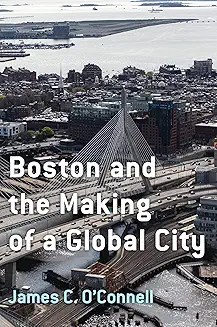
In recent years, Boston has been ranked as one of the foremost global cities for technological innovation. For a mid-sized metropolitan economy that stagnated during the mid-twentieth century, it has been a remarkable achievement. James O’Connell’s Boston and the Making of a Global City tells the story of how Boston took advantage of the 1980s shift in the global economy from domination of manufacturing to emphasis on technological innovation, finance, and professional services. Boston used its vaunted higher education and health care institutions to attract many of the country and the world’s most talented teachers, researchers, and students. The concentration of research and entrepreneurial talent has driven its world-class innovation sectors in life sciences, information technology, robotics, climate technology, artificial intelligence (AI), and supporting finance and professional services sectors. This book describes how Boston has been shaped by the global flows of trade and supply chains, innovation and the dissemination of knowledge, investment, telecommunications, transportation by airplanes and container ships, and immigration.
Currently, Boston’s standing as a leading center of innovation, scientific research, and higher education is jeopardized by federal cutbacks in support of these sectors, as well as an antagonistic mindset toward international migrants and students. These measures have made metropolitan Boston’s economy become vulnerable. O’Connell’s book describes the strengths that have allowed Boston to thrive in the network of competitive global cities and suggests how it can leverage its advantages in uncertain times. This book does not sugarcoat Boston’s achievements—it details the challenges, including housing and socio-economic inequality, facing it. This timely book suggests how globalization could unfold for Boston and other global cities in the face of economic and political disruption.
Copies of Boston and the Making of a Global City (260 pp., $32.95 paper, ISBN: 978-1-62534-862-3) may be ordered through the University of Massachusetts Press at umasspress.com (use code UMASS20 for a 20% discount) or from Amazon, Barnes & Noble, Bookshop.org (independent bookstores gateway), or anywhere books are sold.
Praise for Boston and the Making of a Global City
“The rise of global cities is often seen as a recent development. Using Boston as a case study, James O’Connell offers a deeper analysis of globalization that shows the interconnections of past and present. From the maritime trade of colonial Boston to today’s biotech sector, O’Connell shows us what made the city innovative and prosperous, but also how it fuels social inequality that threatens to undermine the region’s success.”
- Marylynn Johnson, author of The New Bostonians: How Immigrants Have Transformed the Metro Region Since the 1960s
“What is a global city anyway? This excellent book gets urbanists to revisit and rethink this idea through the lens of Boston – an east coast US city that seems both provincial yet global at the same time. O’Connell does a great job exposing Boston’s global-ness but does this mean it really is a global city?”
- Loretta Lees, Director of the Initiative on Cities and Professor of Sociology, Boston University
“Boston is the only city in the world where three major companies did much of their innovative work to successfully develop Covid-19 vaccines. Why Boston? O’Connell brilliantly pulls together what drives Boston to be among the most technologically and medically innovative cities globally.”
- Robert Krim principal author, Boston Made: From Revolution to Robotics Innovations – That Changed the World
“O’Connell offers a comprehensive account of Boston as a participant in the global economy, including an assessment of Boston’s significance in this context. This book will be useful to journalists covering the region; professionals promoting the region; and students and faculty studying the region.”
- Richard Freeland, author of Transforming the Urban University: Northeastern, 1996-2006
 James C. (Jim) O'Connell